Free · Printable · No signup
New entrant safety audit checklist: what a DOT auditor asks for
Rather answer questions? Take the thirteen-question audit readiness score.
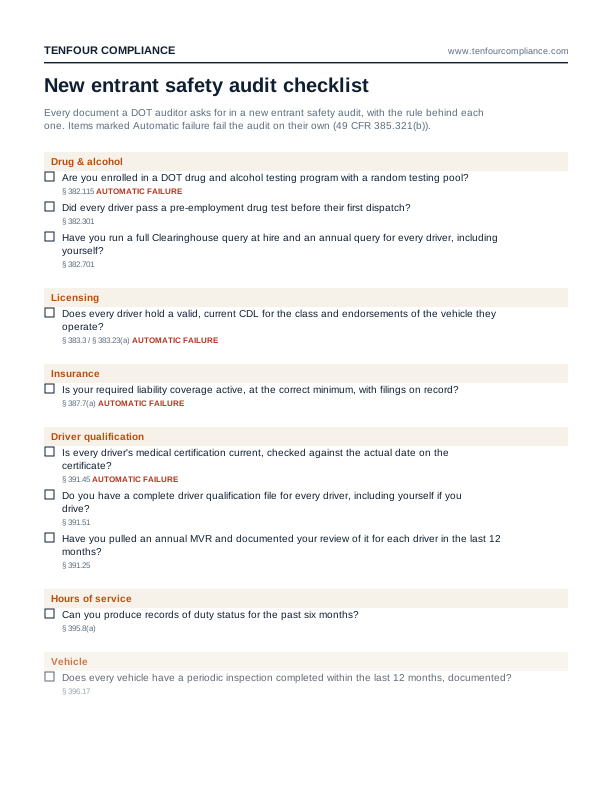
Download the DOT audit checklist (PDF)
Every item below with its rule, and the automatic failures marked, as a PDF you can print or keep on your phone. Free, no signup.
Drug & alcohol
Are you enrolled in a DOT drug and alcohol testing program with a random testing pool? § 382.115Automatic failure
Enroll in a consortium/third-party administrator. An owner-operator cannot run their own random pool. You join a shared one. This fails an audit on a single occurrence.
Did every driver pass a pre-employment drug test before their first dispatch? § 382.301
There is no retroactive fix for a past dispatch, but get the test done now and document it. Using a driver without a passing pre-employment test is a critical violation. It counts toward audit failure on points, not automatically.
Have you run a full Clearinghouse query at hire and an annual query for every driver, including yourself? § 382.701
Run the outstanding queries now. A missing query is provable from a federal database in seconds: there is no benefit of the doubt available.
Licensing
Does every driver hold a valid, current CDL for the class and endorsements of the vehicle they operate? § 383.3 / § 383.23(a)Automatic failure
Verify each license class and endorsement against what the driver actually operates. Knowingly using a driver without a valid CDL is an automatic failure.
Insurance
Is your required liability coverage active, at the correct minimum, with filings on record? § 387.7(a)Automatic failure
Confirm with your agent today that coverage is active and the filing is on record with FMCSA. Operating without required coverage is an automatic failure.
Driver qualification
Is every driver's medical certification current, checked against the actual date on the certificate? § 391.45Automatic failure
Check the real date rather than assuming 24 months; 12-month cycles apply in several situations and examiners certify for less. Using a medically unqualified driver is an automatic failure.
Do you have a complete driver qualification file for every driver, including yourself if you drive? § 391.51
Build each file to the eight items in 391.51(b). Running under your own authority makes you both carrier and driver: a file on yourself is required.
Have you pulled an annual MVR and documented your review of it for each driver in the last 12 months? § 391.25
This is where most files quietly fail, complete at hire, then missed at the twelve-month anniversary. Pull the MVR and write the dated review note.
Hours of service
Can you produce records of duty status for the past six months? § 395.8(a)
Export and retain your ELD records. This item fails the audit when 51% or more of the records examined are deficient, so partial gaps matter less than a systemic absence.
Vehicle
Does every vehicle have a periodic inspection completed within the last 12 months, documented? § 396.17
A sticker alone is not the record. The documentation must identify the vehicle, the date, where the report is kept, and certify that it passed.
Do you keep maintenance and repair records for each vehicle you have controlled for 30 days or more? § 396.3
Keep them one year where the vehicle is housed, plus six months after the vehicle leaves your control. That second period is the one carriers forget when they sell a truck.
Can you confirm you have never operated a vehicle after it was declared out of service, without the violation being corrected? § 396.9(c)(2)Automatic failure
Operating a vehicle declared out of service before the defect is corrected is an automatic failure. Keep the inspection report and the repair certification together.
Registration
Is your MCS-150 biennial update current? § 390.19T
Your deadline comes from your USDOT number, not your registration date. Filing is free and takes minutes.
What goes in a driver qualification file
The eight items in 49 CFR 391.51(b). One file per driver, including yourself, if you drive under your own authority.
- The employment application
- A motor vehicle record from each state that licensed the driver in the past 3 years
- A road test certificate, or an accepted CDL in place of one
- An annual motor vehicle record
- A dated note of your review of that record
- The medical examiner's certificate (or the CDLIS record for CDL holders)
- A note verifying the examiner on the National Registry
- An SPE certificate or medical exemption, where one applies
Clearinghouse query results are required under Part 382 rather than listed in 391.51(b), and are normally kept with your drug and alcohol records. What an auditor cares about is that the queries happened and you can produce proof.
The rule and due date for each item are in the driver qualification file checklist, and DQ file management keeps every file current for you.
Three things worth knowing
- Most failures are filing failures. The document existed; it could not be produced. That is a different problem from unsafe trucking, and it is a much cheaper one to fix.
- Some of this is free. The MCS-150 costs nothing to file. UCR is $55 a year for one truck at ucr.gov for 2027 (up from $46). Anyone charging you for those is charging for the convenience of not doing it yourself, and should say so.
- The audit is on FMCSA’s clock, not yours. FMCSA’s new entrant program runs 18 months from registration (49 CFR 385.307), and the agency’s guidance is to expect the audit within your first 12 months of operating, counted from when you began operations, not from your registration date.
New entrant safety audit checklist questions
For the audit itself, the scoring and what happens after, read how the new entrant safety audit works. If you would rather have someone go through your records against this list first, DOT audit preparation is a mock audit before the real one.
What does a DOT audit consist of?
A new entrant safety audit is a review of your safety management controls and a sample of your records: driver qualification files, records of duty status, vehicle maintenance and inspections, the accident register, the drug and alcohol program, and proof of insurance (49 CFR 385.311). It is scored across six factors, and sixteen violations fail it on their own under 385.321(b).
Is there a DOT audit checklist PDF?
Yes. The checklist on this page is available as a PDF, free and without a signup, from the download button at the top, and the page itself prints cleanly as well.
How long do I have to fix things if I fail?
Most carriers have 60 days from the notice to submit acceptable corrective action, and 45 days for certain passenger and hazardous materials carriers; after that the registration is revoked and an out-of-service order takes effect (49 CFR 385.325).
Last reviewed September 26, 2026. Every item cites the regulation it comes from so you can read the original rather than trust a summary. TenFour is a compliance service, not a law firm, and is not affiliated with FMCSA or any government agency.
If you would rather not track any of this.
TenFour keeps the files, watches the dates and does the filing: the driver files, the consortium paperwork, the Clearinghouse queries, the UCR and the MCS-150, in one place and on one bill. $99/month for the first truck on the annual plan ($119 month to month), $59/month for each additional truck, every driver included. No contract, cancel any month, every price published.
$99/month is the annual plan for one truck, billed $1,188 up front, about two months free against $119 month to month. Each additional truck is $59/month ($69 month to month), every driver included, up to six trucks. Cancel any month; remaining full months refunded.